Skip to content
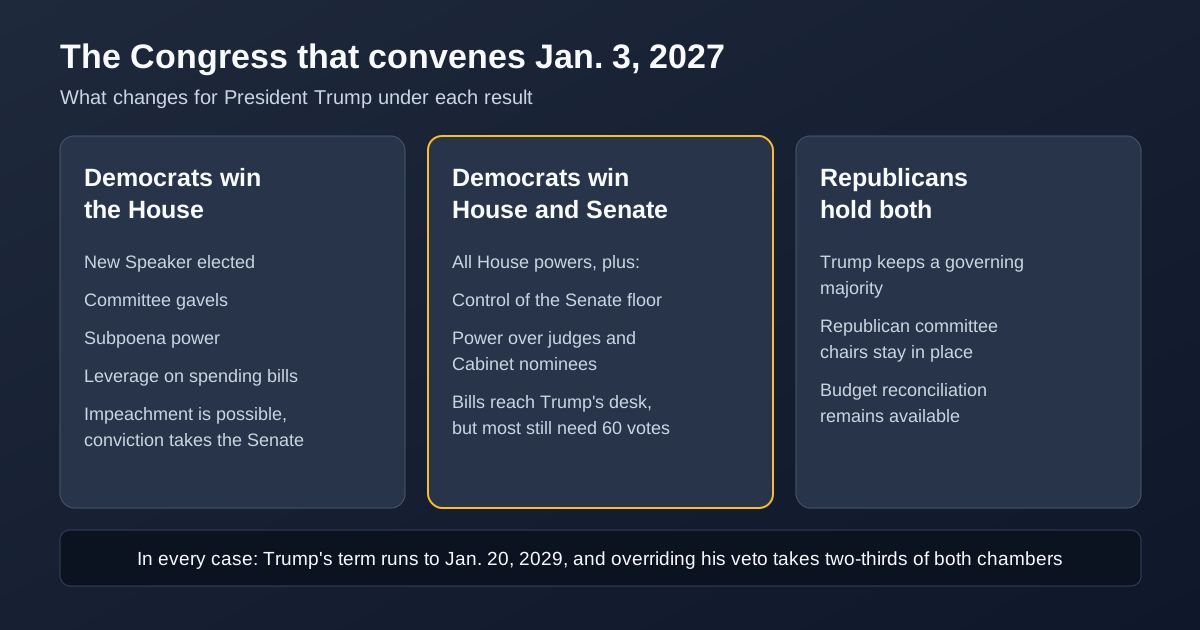
Three scenario cards comparing what changes in 2027 if Democrats win the House, win both chambers, or Republicans hold Congress
|8 min read

What Happens If Democrats Win the Midterms? What Would Change for Trump in 2027

What a Democratic House or Senate could and could not do to Trump in 2027: subpoenas, impeachment, funding fights, judges, vetoes, and the key dates.

The Short Answer

Trump stays president through January 20, 2029, whatever voters decide today. A Democratic win would change who runs Congress: who chairs committees, who issues subpoenas, which bills reach the floor, and who gets confirmed. It would not let Democrats pass their agenda over his veto or remove him from office without Republican votes. A House majority alone would bring investigations, leverage over spending, and an end to Republicans passing bills on their own. Adding the Senate would give Democrats power over judges and Cabinet nominees. No results are in as of this writing, so everything below is conditional. Forecasts favor Democrats: the Silver Bulletin model, as reported by The Conversation on November 2, gave them a 96% chance in the House and 82% in the Senate, and CBS News's Battleground Tracker estimated 229 Democratic House seats, within a range of 215 to 237. Forecasts have been wrong before, and they lean on polling averages with known blind spots, as our guide to house effects explains. The results timeline shows when the answer should become clear.

The Calendar: Nothing Changes Tomorrow

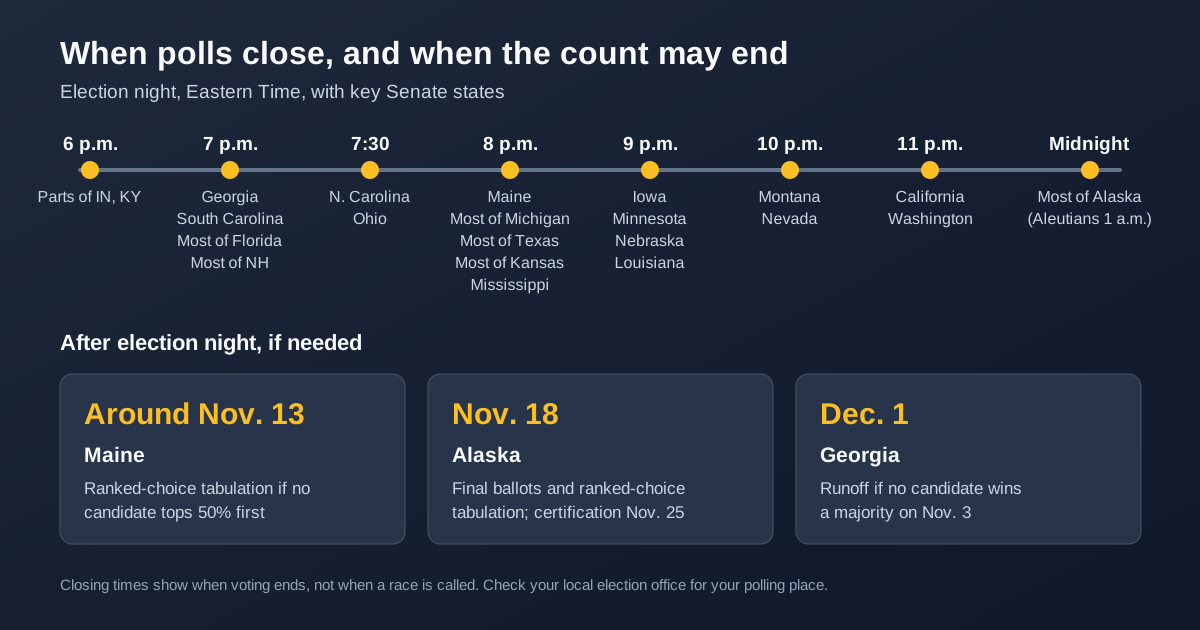
Winning on November 3 does not hand over power on November 4. The current Republican majorities remain in place until the new Congress begins. November 3: Election Day. Some races take days or weeks to settle. Now through early January: The lame-duck session. Republicans still control both chambers. December 11: Stopgap government funding expires under the Continuing Appropriations Act, 2027. Without action, a funding gap could begin December 12. January 3, 2027: The 20th Amendment's default date for the new Congress to convene. New members are sworn in, and the House elects a Speaker before it can do other business. After that: Committees organize, chairs are seated, and subpoena power changes hands. The December deadline matters more than it may look. A party that expects to gain power in January has less reason to make concessions in December, while the outgoing majority has a final chance to pass priorities on its own terms. Expect that tension to shape the next five weeks.

Four Possible Outcomes

Democrats win the House only. Hakeem Jeffries, the current minority leader, is in line to become Speaker. Democrats gain committee gavels and subpoenas and can block Republican bills. The Senate keeps confirming Trump's nominees and would be the end of the road for most House legislation. Forecasts put this behind a Democratic sweep but treat it as a real possibility. Democrats win both chambers. Everything above, plus control of the Senate floor and of confirmations. Bills could now reach Trump's desk, where he can veto them. Most legislation would still need 60 Senate votes. Republicans hold both. Trump keeps a governing majority and investigations stay in Republican hands. Forecasters consider this unlikely. The Conversation's analysis notes that if polls overstate Democrats by four points, they may gain only North Carolina and leave a 52-48 Republican Senate, though the House is a separate question. Democrats win the Senate only. This is the rarest path in current forecasts because the House odds run higher than the Senate odds. It would give Democrats power over nominees and Senate committees, while House Republicans could still block their bills.

Subpoenas and Investigations

This is the change Democrats have planned for most openly, and it would arrive first. The Associated Press reported in September that they are preparing oversight across several committees: - Oversight: Rep. Robert Garcia has named Trump family business dealings, the handling of the Jeffrey Epstein investigation, and ICE operations among his priorities. - Judiciary: Rep. Jamie Raskin, in line to chair, promises to "zero in quickly on the forms of systemic corruption." He also told CNN, as quoted by The Christian Science Monitor, "We're going to use every tool in the toolbox." - Foreign Affairs: Rep. Gregory Meeks plans to look at Trump's international dealings, including around the Iran war and Venezuela operations. - Natural Resources: Rep. Jared Huffman is examining the East Wing demolition for a new ballroom and a proposed arch. "We'll act like the Congress," he said. Expect resistance. AP reported that Democrats are bracing for an administration that may ignore subpoenas or withhold documents, and an August Justice Department legal opinion says executive privilege can cover some of the president's conversations with outside advisers. Enforcing a subpoena through contempt and the courts can take a long time. The fight over Trump's financial records reached the Supreme Court in Trump v. Mazars, which was decided in July 2020, more than a year after the subpoenas were issued. Our guide to verifying court filings shows how to follow a fight like that through the docket.

Will Trump Be Impeached If Democrats Win?

It is possible, not certain, and removal is far less likely than impeachment itself. Trump has predicted it. "I'll get impeached," he told House Republicans at their January 6 retreat, warning them they had to win. Democratic leaders have been deliberately vague. "We haven't ruled anything out," Jeffries said, "and we haven't ruled anything in." Opinion inside the party is split. Reps. Alexandria Ocasio-Cortez and Ro Khanna support pursuing impeachment, according to The Christian Science Monitor, while Sherrod Brown, the Democratic Senate candidate in Ohio, calls it a distraction. AP reports Democrats are more likely to focus on Cabinet members. Rep. Thomas Massie, a Kentucky Republican, has already filed articles against Defense Secretary Pete Hegseth, and Jeffries is reportedly preparing plans of his own on Hegseth. The public is nearly even: an NBC News Decision Desk poll of adults, fielded September 28 to October 12, found 52% wanted a Democratic House to begin proceedings and 48% did not. The math is the real constraint. The House impeaches by simple majority. Convicting in the Senate takes two-thirds of the senators present, which is 67 if all 100 vote. Even the strong Democratic scenario in The Conversation's analysis tops out at 55 seats plus independent Dan Osborn of Nebraska. The Senate acquitted Trump in both earlier trials.

Laws, Vetoes, and the Budget

Democrats have promised plenty. Jeffries set up working groups on housing, health care, groceries, gas and utilities, and caregiving, and he wants votes to overturn tariffs, reverse Medicaid cuts and end the Iran war. Turning those promises into law is much harder. Most bills need 60 votes in the Senate, and Trump can veto anything that passes. Overriding a veto takes two-thirds of both chambers. In his first term Trump vetoed 10 bills, and Congress overrode just one. Leverage is more realistic than legislation. Annual spending bills and the debt limit have to pass, so a Democratic House could use them to bargain, and The Christian Science Monitor notes it may try to attach conditions such as defunding immigration enforcement. That carries shutdown risk, which is why the December 11 deadline is worth watching. The 2018 midterms were followed by a five-week partial shutdown as the new House majority took over. Republicans would lose a tool as well. Budget reconciliation lets a majority pass certain fiscal bills without 60 Senate votes, but they must still clear both chambers, so a Democratic House would close that route. Analyst Molly Reynolds told the Monitor that divided government "is not always a recipe for a lot of legislative productivity," though some experts note Trump has cut deals with Democrats before.

What a Senate Majority Adds

The Senate confirms Cabinet secretaries and federal judges, usually by simple majority, and the majority leader decides what comes to the floor. Sen. John Thune holds that job now. A Democratic majority could slow or refuse nominees for the final two years of Trump's term, including any Supreme Court vacancy. Presidents have workarounds, especially acting officials, but those have legal limits explained in our guide to the Federal Vacancies Reform Act. The Senate would also become a second venue for investigations. Our policy and governance hub collects related explainers.

What Would Not Change

Plenty of presidential power does not run through Congress day to day. Trump could still issue executive orders and emergency declarations, direct federal agencies, conduct diplomacy and command the military, subject to lawsuits and to whatever limits Congress can pass over a veto. His calendar would not pause either. He is expected in Manila and Shenzhen later this month, and U.S.-Iran talks continue after the November 2 strikes on Qeshm Island. Our live tracker and schedule page will keep recording where he goes, whoever runs Congress.

The 2018 Precedent, and Where It Falls Short

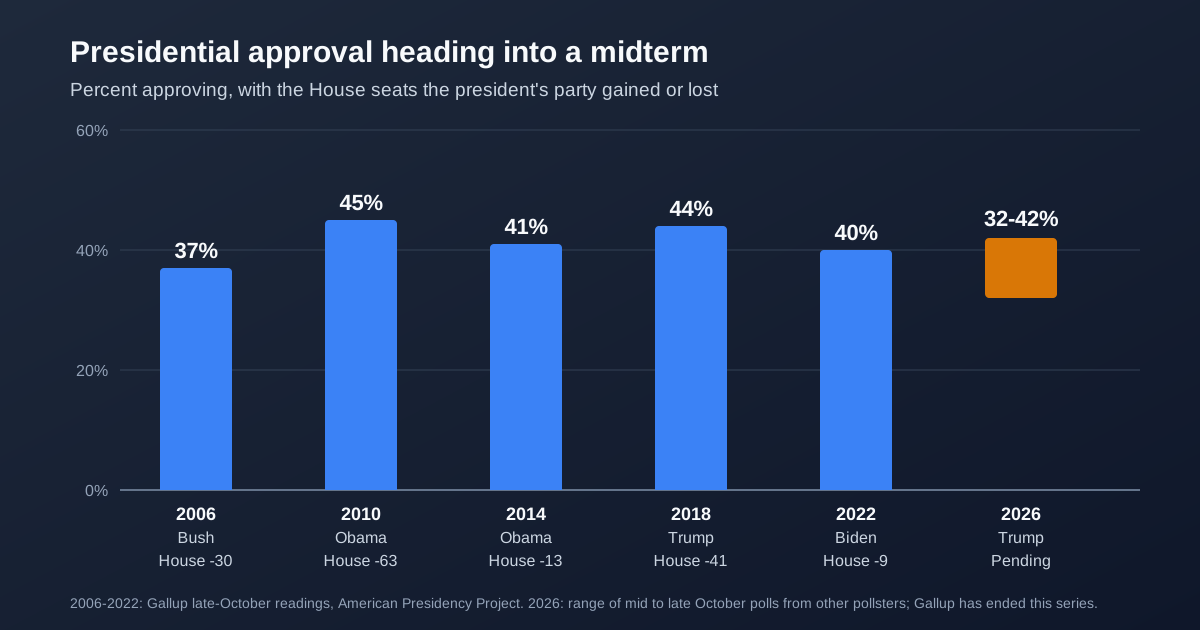
The closest model is Trump's own first midterm. In 2018 his party lost 41 House seats and gained two in the Senate, according to the American Presidency Project's figures. Democrats took the House, Nancy Pelosi became Speaker, and the next two years brought subpoena battles, the partial shutdown and his first impeachment in December 2019. A Republican Senate then acquitted him and kept confirming judges. The difference this time is the Senate map. In 2018 Democrats were defending seats in states Trump had won. In 2026 Republicans are the ones defending most of the competitive seats, so Democrats could hold both chambers for the first time during either Trump presidency. That would make the last two years of this term quite different from 2019 and 2020.

Frequently Asked Questions

What happens if Democrats win the House? They would elect the Speaker, likely Hakeem Jeffries, and take control of committees and subpoenas on January 3, 2027. The Senate and Trump's veto would limit what becomes law. What happens if Democrats win both the House and Senate? They would also control confirmations and could send bills to Trump's desk. Most bills would still need 60 Senate votes and could be vetoed. Would Trump be removed from office if impeached? Only if two-thirds of the Senate votes to convict, which would require substantial Republican support under any projected outcome. When would Democrats take over? On January 3, 2027. Republicans keep their majorities until then. Could there be a government shutdown? Current funding runs through December 11, 2026. Congress must extend it or pass new bills to avoid a lapse.

Sources

what happens if Democrats win the midtermswhat happens if Democrats win the Housewhat happens if Democrats win House and Senatewill Trump be impeached if Democrats winwill Trump be impeached after the midterm electionsif Democrats win the House who will be speakerHakeem Jeffries speakerHouse Democrats oversight plans Trumpnew Congress January 3 2027lame duck session December 11 funding deadline
LT

LocateTrump Research Team

An independent team of developers, data analysts, and researchers tracking presidential location and activity using publicly available information from 10+ major news sources. Operating continuously since January 20, 2025. All content follows our editorial standards for source verification and accuracy.

Related Articles
Further Reading

Need deeper document-level context? Continue with carefully sourced long-form coverage.

Research Pathways for This Topic

Use these targeted internal paths to move from this article into related hubs, timelines, and data-backed tracking pages.

Explore LocateTrump

See presidential location data in action with our live tools.