Skip to content
Timeline of 2026 election night poll closings from 6 p.m. to 1 a.m. Eastern with key Senate races, followed by later dates for Maine, Alaska and a possible Georgia runoff
|7 min read

When Will Midterm Results Be Known? Poll Closing Times and the Slow-Count States

Poll closing times for every key Senate race, which states count fast or slowly, and why Maine, Alaska and Georgia could keep Senate control open.

When Results Arrive, in Brief

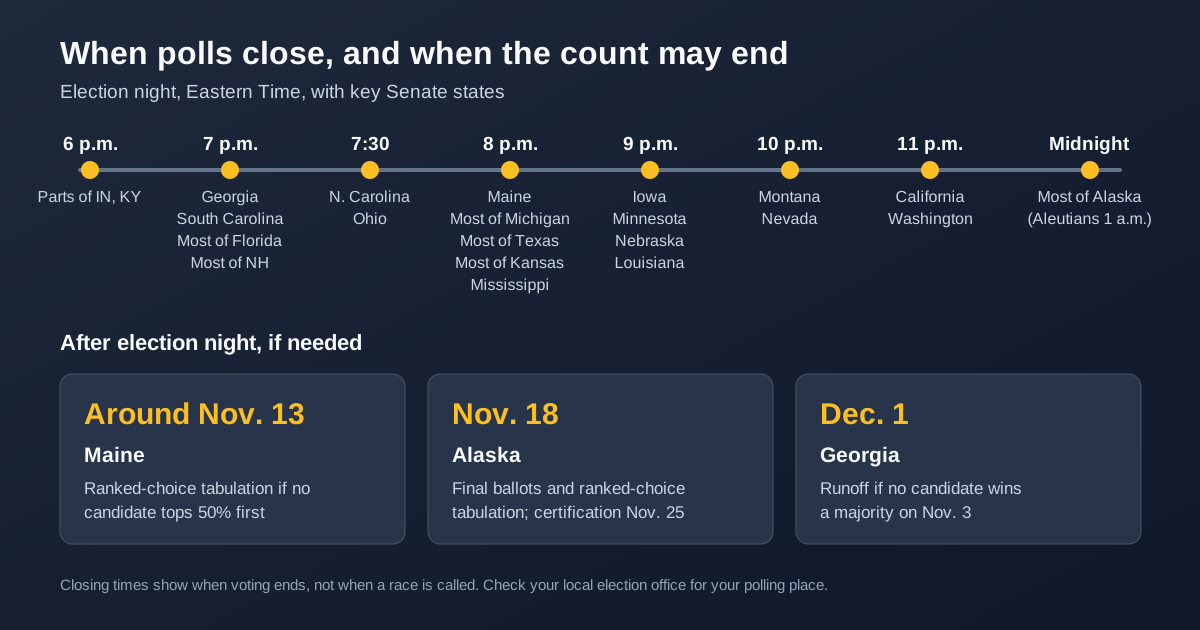
The first polls close at 6 p.m. Eastern tonight in parts of Indiana and Kentucky, and the last close at 1 a.m. Wednesday in Alaska's Aleutian Islands. Clear races are often called within minutes of those closings. Close ones can take hours, days or longer. Control of the House may take days, as it did in 2022 and in 2024, when it took eight days. Control of the Senate could be known tonight if one party wins decisively, but three later dates could keep it open: around November 13 for a possible ranked-choice count in Maine, November 18 for Alaska's final count and tabulation, and December 1 for a possible Georgia runoff. A first report of votes is not a result, and a projection by a news organization is not certification. Our guide to election-night returns versus certified results explains that gap in detail.

Poll Closing Times by Key Senate Race

All times are Eastern and show when polls close, not when a race will be called. Pairings follow NPR's list of races to watch and other reporting. People in line at closing time can generally still vote, so check with your local election office. 6 p.m.: Parts of Indiana and Kentucky 7 p.m.: Georgia (Jon Ossoff vs. Mike Collins), South Carolina (Darline Graham vs. Annie Andrews), most of Florida (Ashley Moody vs. Angie Nixon), most of New Hampshire (Chris Pappas vs. John Sununu), Virginia, Vermont 7:30 p.m.: North Carolina (Roy Cooper vs. Michael Whatley), Ohio (Jon Husted vs. Sherrod Brown), West Virginia 8 p.m.: Maine (Susan Collins vs. Troy Jackson), most of Michigan (Mike Rogers vs. Abdul El-Sayed), most of Texas (Ken Paxton vs. James Talarico), most of Kansas (Roger Marshall vs. Adam Hamilton), Mississippi (Cindy Hyde-Smith vs. Scott Colom and Ty Pinkins), Pennsylvania, New Jersey, the rest of Florida and New Hampshire 8:30 p.m.: Arkansas 9 p.m.: Iowa (Ashley Hinson vs. Josh Turek), Minnesota (Peggy Flanagan vs. Michele Tafoya), Nebraska (Pete Ricketts vs. Dan Osborn), Louisiana, New York, Arizona, Colorado, Wisconsin, the rest of Michigan, Kansas and Texas 10 p.m.: Montana, Nevada, Utah, parts of Idaho and Oregon 11 p.m.: California, Washington, the rest of Idaho and Oregon Midnight: Hawaii and most of Alaska (Dan Sullivan vs. Mary Peltola) 1 a.m. Wednesday: The western Aleutian Islands

Which States Tend to Count Quickly

Al Jazeera's guide used 2024 data to show how fast the early reporters can move. Florida had about 99% of its vote counted by 10:51 p.m. Eastern that year. Ohio started reporting six minutes after polls closed and reached 90% by 11:03 p.m. North Carolina reached 90% by 11:36 p.m. Pennsylvania reached half by 10:12 p.m. and 90% by 12:48 a.m., and Wisconsin got to 90% at 2:22 a.m. These are last cycle's numbers and tonight's will differ, but the pattern usually holds because these states process early and mail ballots quickly. Early vote totals are large this year: more than 59 million before today, according to University of Florida figures cited by CBS News, compared with nearly 46 million in all of the 2022 midterms. That matters because the first batch in many states may be mostly early votes, whose partisan mix can differ from the Election Day vote that follows.

Why Some Races Will Not Be Called Tonight

Four things usually delay a call: - Mail ballots. California, which votes largely by mail, can take days or weeks to resolve close House races. Washington and Oregon also vote by mail. Arizona has to check signatures on ballots dropped off on Election Day. Nevada accepts ballots postmarked by today for up to four days, and voters there have six days to fix signature problems. - Late-arriving ballots. In Watson v. Republican National Committee, decided June 29, the Supreme Court upheld Mississippi's law counting ballots postmarked by Election Day that arrive within five business days. CBS News counts 14 states and D.C. that accept such ballots, and more allow them for military and overseas voters. - Fixing ballot errors. Many states let voters correct a missing or mismatched signature after Election Day, as our absentee signature verification guide explains. - Recounts and challenges. Recounts can be automatic or requested, and lawsuits can extend the process. Under the Constitution, each chamber of Congress has the final word on its members' elections.

Three Dates That Could Matter After Tonight

Maine, around November 13. Maine uses ranked-choice voting in federal general elections. Six declared write-in candidates and blank first choices could keep both Susan Collins and Troy Jackson under 50%. If so, the race goes to tabulation in Augusta. Municipalities have two days to report, and Secretary of State Shenna Bellows told USA Today that tabulation has typically finished by the Friday of the following week, though officials hope to go faster. She called the scenario "highly possible" and said it would be the first time a Maine U.S. Senate race has gone to ranked choice. Alaska, November 18. Dan Sullivan and Mary Peltola share a four-name ballot that also lists Daniel J. Sullivan Jr. and Gerald Heikes. The state counts absentee ballots on Election Day and in scheduled updates on November 10 and 13. The Anchorage Daily News reports that all remaining votes will be counted on November 18, with ranked-choice tabulation the same day and certification on November 25. Alaska's Senate race has also drawn a federal lawsuit over voter confusion, which a judge dismissed on November 1. Georgia, December 1. Georgia requires a majority, so if neither Jon Ossoff nor Mike Collins clears 50%, the top two face a runoff. Congress Countdown lists Mississippi as a second possible December 1 Senate runoff, and an independent is on the ballot there alongside the two major-party nominees.

How Long It Took Before

Recent midterms show why patience pays. In 2022, the Associated Press did not call control of the Senate until Saturday, November 12, four days after the election, when a Clark County batch settled Nevada's race. The House took longer: a week after the vote, AP had Republicans at 217 seats, one short of a majority, largely because of uncalled races in California, and control was settled the following Wednesday. In 2024, determining House control took eight days. AP's stated standard explains the wait. It does not call a race until it determines there is no scenario that would allow the trailing candidate to close the gap, so a narrow lead with many outstanding ballots stays uncalled.

How to Follow the Senate Math Tonight

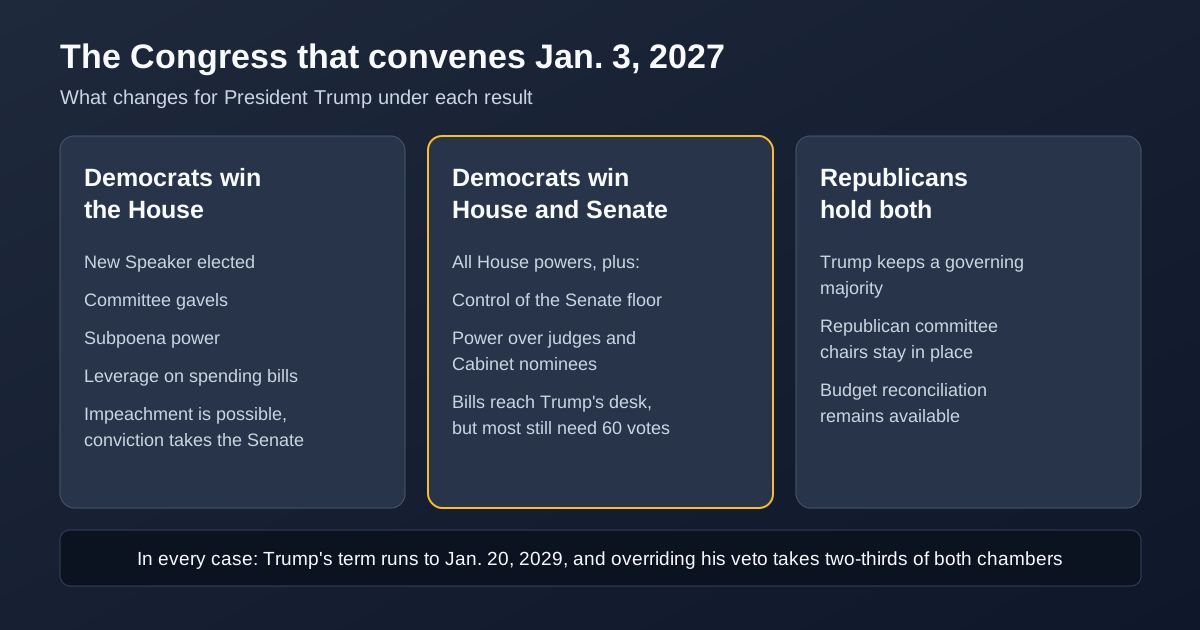
Republicans hold 53 seats and Democrats 47, so Democrats need a net gain of four seats to reach 51. Vice President Vance would break a 50-50 tie for Republicans. Here is a practical way to read the night, based on the closing times and rules above: First read, 7 to 7:30 p.m.: Georgia, a Democratic seat, and North Carolina and Ohio, two Republican seats with fast counts. If Democrats win North Carolina and Ohio and hold Georgia, they are halfway there. Middle of the night, 8 to 9 p.m.: Michigan, a Democratic seat they must hold or else need a fifth pickup, plus Republican seats in Texas, Kansas and Iowa. Late and slow: Maine and Alaska. If the 51st seat depends on either, Senate control may not be settled tonight. A clear first-round majority in Maine could still allow a quick call. Alaska is slower by design: about a quarter of its 2024 vote was still uncounted the next morning. The House is more straightforward in principle: 218 seats is a majority. Republicans now hold 218 plus an independent who usually caucuses with them, and Democrats 214, with two vacancies. CBS identified 47 battleground districts, and redistricting shapes how many are truly in play. For what each outcome would mean, read what happens if Democrats win.

After the Calls: Certification

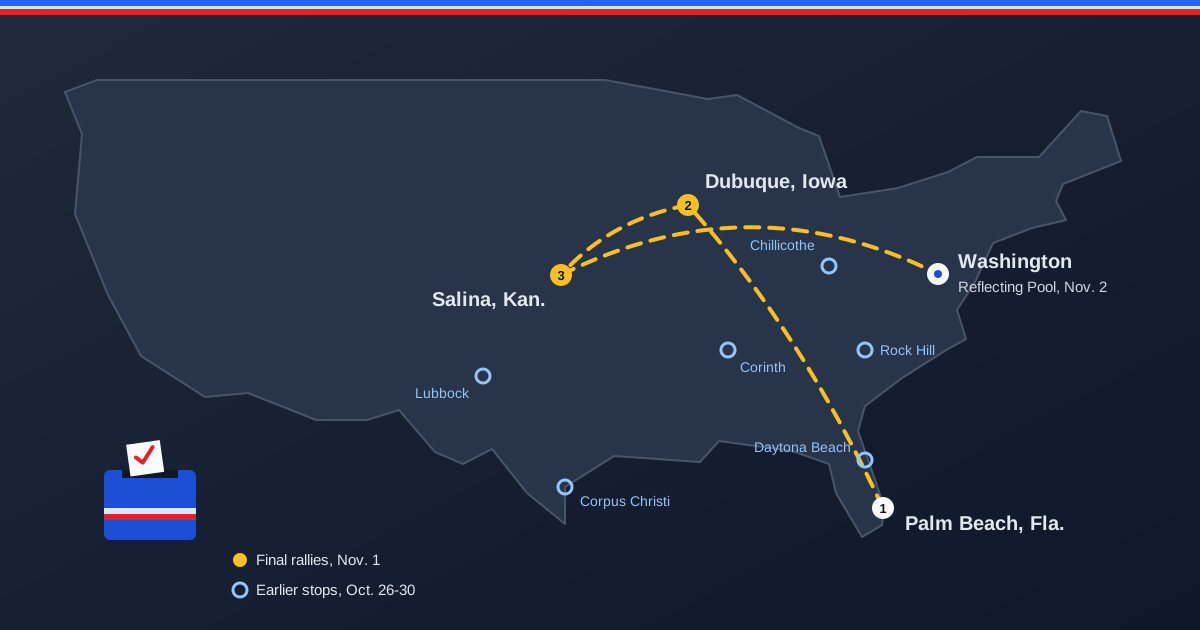
A race call is a news judgment based on the available vote. The legal result comes when states certify, which happens between November 10 and December 18 this year, according to a Ballotpedia calendar cited by Congress Countdown, with some states setting no fixed date. Newly elected members take office on January 3, 2027. Trump's own plans for tonight are simple: a White House official told CBS News that he will monitor election night from the White House. You can follow any confirmed movement on our live tracker, and his final campaign stops are mapped separately.

Frequently Asked Questions

What time do polls close on Election Day 2026? The first close at 6 p.m. Eastern and the last at 1 a.m. Eastern on Wednesday. Many key Senate states close between 7 and 9 p.m. Eastern. When will midterm results start coming in? Shortly after the first polls close at 6 p.m. Eastern, with larger waves after 7, 8 and 9 p.m. When will we know who won the Senate? Possibly tonight if the outcome is lopsided. If it rests on Maine or Alaska, it may take until mid-November, and a Georgia runoff could extend it to December. Why does California take so long? It votes largely by mail and must verify ballots after the polls close, which can delay close House races for days or weeks. Are election-night numbers final? No. They are unofficial until states finish counting and certify.

Sources

when will midterm results be knownwhen will midterm results come outwhen will midterm results start coming inwhat time do polls closepoll closing times 2026when will we know who won the SenateSenate election results timelineGeorgia Senate runoff date 2026Alaska ranked choice results November 18Maine Senate ranked choice tabulation
LT

LocateTrump Research Team

An independent team of developers, data analysts, and researchers tracking presidential location and activity using publicly available information from 10+ major news sources. Operating continuously since January 20, 2025. All content follows our editorial standards for source verification and accuracy.

Related Articles
Further Reading

Need deeper document-level context? Continue with carefully sourced long-form coverage.

Research Pathways for This Topic

Use these targeted internal paths to move from this article into related hubs, timelines, and data-backed tracking pages.

Explore LocateTrump

See presidential location data in action with our live tools.