Skip to content
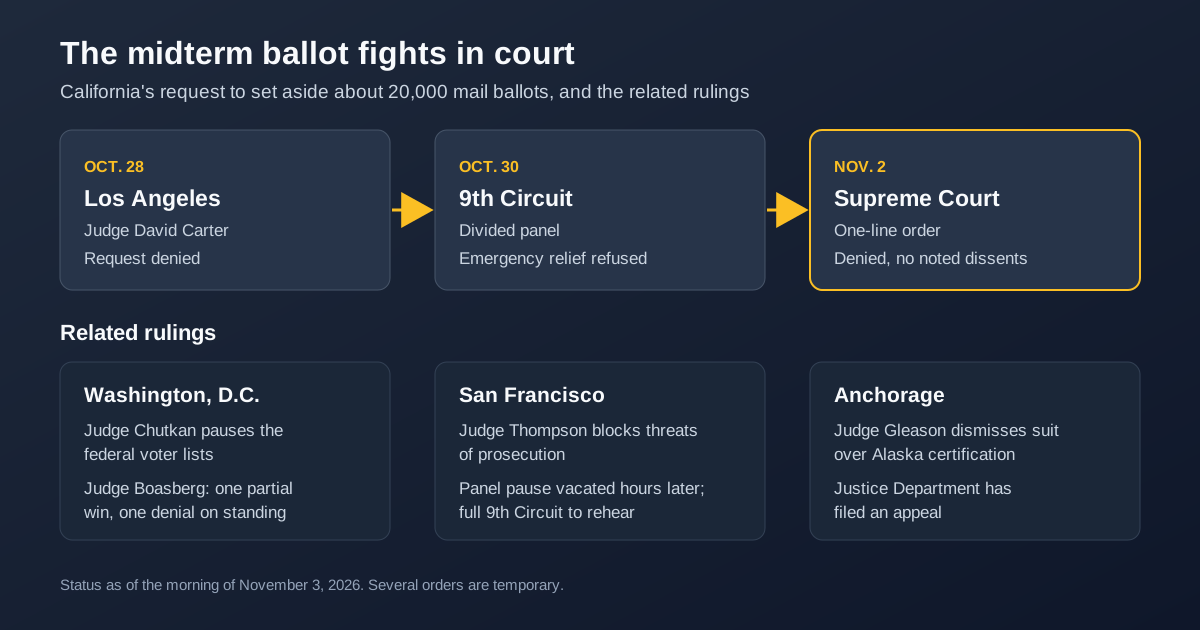
Flow diagram showing the California ballot request denied by a Los Angeles federal court, the 9th Circuit and the Supreme Court, with related rulings in Washington, San Francisco and Anchorage
|9 min read

Trump DOJ vs. the States: The Midterm Ballot Court Fights, Explained

The Supreme Court, five federal judges and the 9th Circuit weighed Trump DOJ ballot demands before Election Day. Each case, its outcome, and what's open.

Where the Fights Stand on Election Morning

Entering Election Day, no court had let the Trump administration make a state set aside ballots. In the final weeks before the vote, the Justice Department and Department of Homeland Security pressed states to separate ballots from people on federal lists of suspected noncitizens, warned that officials could face prosecution, and sued to block Alaska from certifying a Senate result. The Supreme Court turned down the California request on Monday in a one-line order. Federal judges in Los Angeles, Washington, D.C., San Francisco and Anchorage ruled against the government on the major requests, although one ruling also went against Democratic groups, and several of these orders are temporary. Noncitizen voting in federal elections is illegal, and the administration argues it is enforcing that law. Reuters describes the available evidence as showing such voting is exceedingly rare. Here is what each court decided, and what remains open.

The Scorecard

California ballots: Judge David Carter denied the request on October 28. The 9th Circuit refused emergency relief on October 30. The Supreme Court denied it on November 2. Federal lists to states: Judge Tanya Chutkan temporarily barred DOJ and DHS from sending more lists or asking states to act on them on November 2. DHS demands to California: Judge James Boasberg granted part of a request by an immigrant-rights group on November 2. Democratic committees' suit: Judge Boasberg denied it for lack of standing. Threats of prosecution: Judge Trina Thompson blocked them on October 30. A 9th Circuit panel paused her order 2-1 on November 2, and the full court vacated that pause hours later. Alaska certification: Judge Sharon Gleason dismissed the suit on November 1. DOJ has appealed. Election monitors: About 1,000 are deployed across 50 states. Access to polling places depends on state and local rules.

California's 20,000 Ballots: From Los Angeles to the Supreme Court

DOJ sued on October 15, saying it had compiled "a list of over 20,000 names of people" it believes are likely noncitizens and asking that their vote-by-mail ballots be set aside until citizenship could be confirmed. At a hearing, First Assistant U.S. Attorney Bill Essayli said, "We're not telling California what they have to do. We're telling them what they can't do." Christina McCall, an attorney for California, replied, "Where is the evidence?" On October 28, Judge Carter refused, writing that the request "violates longstanding constitutional principles mandating that states have control over their elections." At the hearing the day before, he had suggested another course. If noncitizen voting is a crime, he asked, "Don't you have the power of indictments?" He added, "Go out and indict." The 9th Circuit declined to step in on a divided vote, and DOJ went to the Supreme Court on November 2. That order came within hours on the court's emergency docket, without asking California to respond and with no noted dissents. There was a practical obstacle as well. Thousands of mail ballots had already been processed, and identifying details are discarded after signature checks, so NBC News reports it would be "impossible to retroactively determine" which votes came from those on the list. The strongest judicial support for DOJ came from Judge Patrick Bumatay, who dissented from an earlier 9th Circuit order and wrote that "federal law precludes California from commingling ballots likely cast by aliens with legitimate ballots." Our absentee signature guide explains that verification step.

Are the Federal Lists Reliable?

The accuracy of the lists became central, and the government's own lawyer conceded a problem. When Judge Thompson asked DOJ attorney Kenneth Kao whether "there is a high error rate" in the California list, he answered, "I think that's a fair statement," according to NBC News. He argued that the errors were why counties need to help verify it. Nevada is the most detailed example. NBC reported that DHS first identified up to 15,903 registered voters there, then 6,218, then 185 after manual review, and that state officials later confirmed "all 185 individuals were citizens." In Washington state, Secretary of State Steve Hobbs said the federal list contained "many" U.S. citizens. Judge Carter wrote that the court "cannot conclude that Plaintiff's process is credible." On November 2, Judge Chutkan temporarily barred DOJ and DHS from sending such lists to more states or asking officials to set ballots aside. Challengers argued that the program violated the Privacy Act of 1974. She wrote that the voting law the government cited, 18 U.S.C. 611, "contains no language authorizing the broad program of bulk transmission of sensitive voter data." DOJ had argued that its letters to California and Washington were enforcement of that law and did not amount to a distinct policy that a federal court could review.

Threats of Prosecution and a Same-Day Reversal

The most confusing ruling came late on Monday, and early reports may be out of date. On October 30, Judge Thompson in San Francisco issued an order, set to expire November 16, barring the government from threatening election officials with prosecution for counting ballots from people it deems ineligible. She found that the threats likely violated the Voting Rights Act's ban on intimidation and coercion. On November 2, a 9th Circuit panel paused that order 2-1, with Judges Carlos Bea and Consuelo Callahan in the majority and Judge Mary Murguia in dissent. The panel called the government's actions "core Executive functions." Just hours later, a majority of the court's active judges vacated the panel's ruling and agreed to hear the request en banc, as a full court, with no date specified. As of Tuesday morning, then, the panel's stay is gone. If you saw a headline saying the government was cleared to threaten officials, it likely reflects the earlier order.

Why Democrats Lost a Round While an Immigrant-Rights Group Won

Judge Boasberg's two rulings show why standing often decides election cases before the merits are reached. Standing asks whether the party suing has suffered, or is about to suffer, a concrete injury that a court can fix. A coalition of the Democratic Senatorial Campaign Committee, the Democratic Congressional Campaign Committee, the Democratic Governors Association and the Nevada State Democratic Party lost. "Even extraordinary merits questions cannot justify the extraordinary relief of a preliminary injunction or temporary restraining order if those seeking it lack standing," he wrote, adding that they "offer no evidence that any state election official has segregated or refused to tabulate the ballot" of someone on these lists. The Coalition for Humane Immigrant Rights and a naturalized citizen did better. Boasberg found the group likely had standing and partly granted its request, barring DHS from demanding that California officials segregate ballots based on the lists. He wrote that the executive branch "has likely violated" the Constitution's Elections Clause. The same judge reached different outcomes for different plaintiffs on closely related facts, because the plaintiffs had shown different injuries.

Alaska and the Two Dan Sullivans

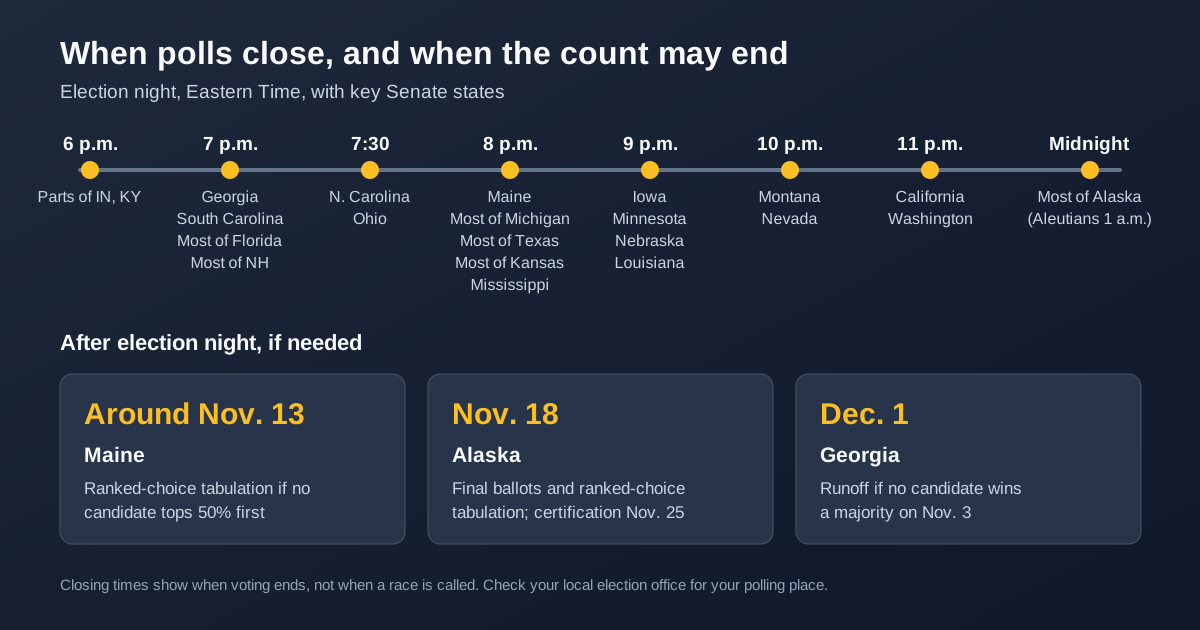
Alaska's dispute is unlike the others. Sen. Dan S. Sullivan, a Republican, faces Democrat Mary Peltola in a toss-up race, and the ballot also lists Daniel J. Sullivan Jr., a retired teacher from Petersburg. Trump, the senator and other Republicans call him a "sham" and a "hoax." A New York Times account, cited by Alaska Public Media, alleges that Democratic operatives recruited spoiler candidates to help Peltola; she denies it. The Alaska Supreme Court ruled this summer that he has a right to be on the ballot, and state law does not bar spoiler candidates. To reduce confusion, the Division of Elections labels the senator "Dan S. Sullivan, Republican incumbent." DOJ sued on October 22 to block certification of "any result that may be impacted by voter confusion" and to have ballots marked for the other Sullivan set aside. Trump said he ordered the lawsuit. Alaska's Department of Law called the idea "half-baked," arguing ballots carry no names and are mixed in the box. On November 1, Judge Gleason dismissed the suit, writing that the U.S. "provides no workable plan" to separate and investigate those ballots while preserving secrecy. DOJ filed a notice of appeal within an hour. The dispute has a criminal side too. U.S. Attorney Michael Heyman said the government is investigating whether a crime occurred and described "a surge in FBI resources." A state lawmaker said agents visited at least two constituents to ask whether they knew who they were donating to. A poll released Friday showed Peltola up two points, with the second Sullivan above 4%. That margin is the reason this matters. Alaska will not finish counting until November 18.

1,000 Election Monitors: What They Can Do

The Justice Department calls this its "largest monitoring effort in history," with about 1,000 monitors in all 50 states, up from 289 in 2022 and 714 in 2024. Named locations include Fulton, Cobb, DeKalb and Gwinnett counties in Georgia; Harris, Dallas and Bexar in Texas; Cuyahoga and Franklin in Ohio; Detroit, Dearborn and six other cities in Michigan; and Philadelphia, Allegheny, Lehigh and Luzerne in Pennsylvania, among others. Harmeet Dhillon, who heads the Civil Rights Division, said "election integrity has been one of the top priorities." Monitors have limited authority. "Our monitors only observe and take notes," DOJ attorney James Catania wrote, as reported by Spotlight PA. They may enter polling places only with permission from local officials. Pennsylvania's Al Schmidt said they are "not legally entitled to any greater access to polling places than any member of the public." Colorado, Indiana and Wyoming have said they will not allow monitors within a certain distance of polling places, and federal and state law bar monitors from intimidating voters.

What the Rulings Do Not Settle

These orders are mostly emergency decisions made on tight deadlines. The Supreme Court gave no explanation, so its order sets no clear rule for future cases. Judge Chutkan cited the Purcell principle, the doctrine that courts should be wary of changing election rules close to a vote, and that same doctrine helps explain the speed of these rulings. It says little about what happens after the election. The full 9th Circuit has yet to rule on the prosecution threats, Alaska's case is on appeal, and Judge Thompson's order runs until November 16. Judge Carter's point stands as well: the government can still bring criminal charges in individual cases where it has evidence. Close results may bring new disputes, and states certify from November 10 through December 18. Each chamber of Congress is the final judge of its members' elections. Our guide to returns and certified results provides useful background if those fights arrive.

What This Means If You Are Voting Today

None of these rulings changes how you cast a ballot. Vote according to your state's normal rules and check deadlines with your county election office, especially for returning a mail ballot, which our mail ballot guide covers. DOJ lists a public line for election complaints, 800-253-3931. Before sharing a claim about a court order today, check the date, because several of these rulings changed within hours.

Frequently Asked Questions

Did the Supreme Court rule on noncitizen ballots? It denied the administration's emergency request to make California separate about 20,000 mail ballots. The one-line order gave no reasons and had no noted dissents. Can the federal government make a state set aside ballots? No court had allowed it as of November 3. States run elections under the Constitution, subject to laws passed by Congress, and judges found the administration's approach likely unlawful or unsupported. Why are there two Dan Sullivans on Alaska's ballot? A retired Petersburg teacher named Daniel J. Sullivan Jr. qualified alongside the incumbent, and the Alaska Supreme Court upheld his right to run. Republicans call his candidacy a sham. Can DOJ election monitors enter polling places? Only with local permission. Otherwise they must observe from outside. Is noncitizen voting illegal? Yes, in federal elections under 18 U.S.C. 611, and Reuters reports the available evidence shows it is exceedingly rare.

Sources

Supreme Court California ballots noncitizensDOJ noncitizen voter list California 20,000 ballotsJudge Chutkan noncitizen voter lists orderJudge Boasberg California ballots orderAlaska Senate DOJ lawsuit dismissedtwo Dan Sullivans Alaska ballotDOJ election monitors 2026can the federal government set aside ballotsNinth Circuit en banc election officials threatsPurcell principle midterms
LT

LocateTrump Research Team

An independent team of developers, data analysts, and researchers tracking presidential location and activity using publicly available information from 10+ major news sources. Operating continuously since January 20, 2025. All content follows our editorial standards for source verification and accuracy.

Related Articles
Further Reading

Need deeper document-level context? Continue with carefully sourced long-form coverage.

Research Pathways for This Topic

Use these targeted internal paths to move from this article into related hubs, timelines, and data-backed tracking pages.

Explore LocateTrump

See presidential location data in action with our live tools.