Skip to content
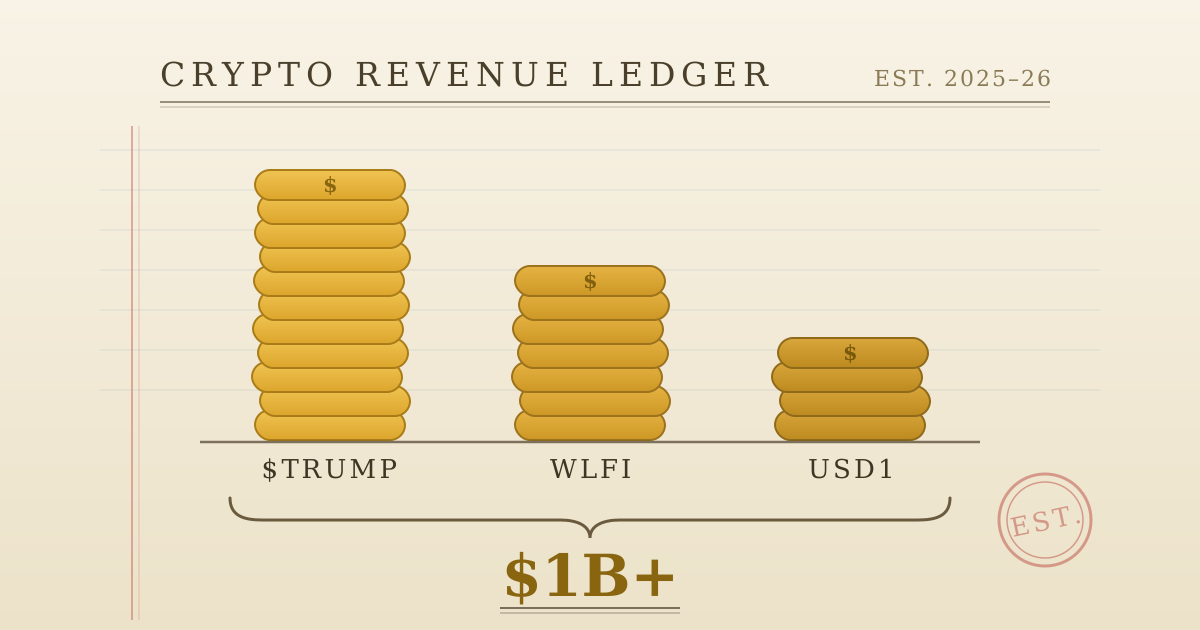
Stacked golden coin columns representing Trump family revenue from the TRUMP memecoin, World Liberty Financial, and the USD1 stablecoin, totaling more than one billion dollars
|10 min read

How Much Money Has Trump Made From Crypto? The $1 Billion Breakdown

Trump-linked ventures have netted the family more than $1 billion from crypto, per CNN. We break down $TRUMP, WLFI, and USD1 revenue line by line, with sources.

The Headline Number

More than one billion dollars — that is what Trump-linked crypto ventures have brought the president's family since early 2025, according to CNN's July 2026 accounting. It is a striking figure, and it deserves careful unpacking, starting with what "made" actually means here. The billion-plus total blends several very different kinds of money: trading fees collected in cash by entities affiliated with the family, proceeds from token sales, a share of revenue generated by a stablecoin's reserves, and the paper value of tokens the family still holds. Realized cash and mark-to-market holdings are not the same thing — token values can fall, and some already have, dramatically — so the precise figure moves with the market. It is also family-level accounting rather than a statement about the president's personal checking account: the ventures involved are structured through companies in which Trump family members hold stakes of varying sizes. What makes the number remarkable either way is its speed and its source. This is revenue generated during a presidency, from an industry the administration actively regulates, through three main channels — the $TRUMP memecoin, World Liberty Financial, and the USD1 stablecoin. The sections below take each one in turn.

$TRUMP: Fees on the Way Up and Down

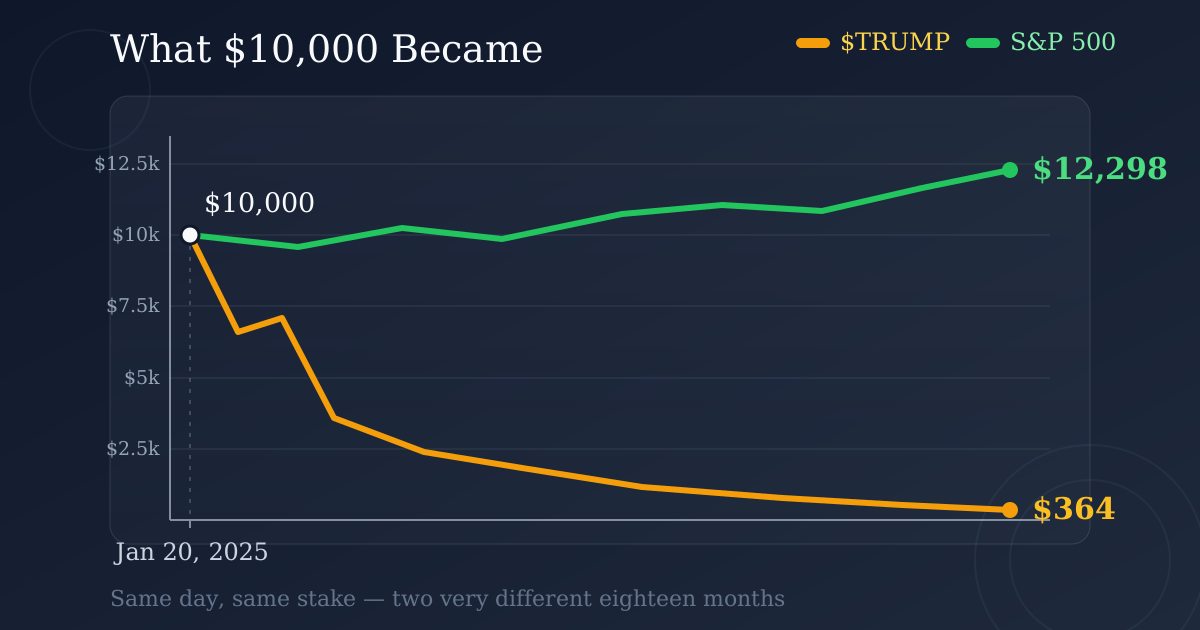
The memecoin came first, and it illustrates the most important mechanic in this entire story: the house collects fees whether the price rises or falls. When $TRUMP launched on Solana on January 17, 2025, and spiked to an all-time high of roughly $74 to $75 two days later, entities affiliated with the Trump family controlled the bulk of the token supply and earned trading fees on the torrent of buying. When the price then collapsed — it trades under $2 today, a drawdown of roughly 98 percent — those same entities kept earning fees on the selling. Retail holders bore the price risk; the affiliated entities captured revenue from volume in both directions. The venture also found ways to monetize the coin beyond fees. In May 2025, a private dinner was held for the largest $TRUMP holders, an event that briefly pushed the price up as buyers competed for leaderboard positions, and that drew congressional criticism over the spectacle of access to the president being tied to purchases of his token. Whatever one's view of that controversy, the revenue math is not in dispute: the coin generated hundreds of millions of dollars in fees and related income for its affiliated entities even as most buyers lost money. The current price, the drawdown, and the event timeline all live on our live tracker.

World Liberty Financial and the WLFI Crash

World Liberty Financial is the family's decentralized-finance venture, and its WLFI token has become the clearest example of the gap between insider outcomes and buyer outcomes. The token trades around $0.08 today, down roughly 74 percent from where public trading began, which means the typical outside buyer is deeply underwater even as the venture itself raised enormous sums selling tokens. Two strands of reporting sharpened the questions around WLFI this year. In April 2026, Fortune's insider-loan reporting examined arrangements under which insiders could effectively borrow against or extract value from token positions in ways unavailable to ordinary holders. Then Justin Sun — the crypto entrepreneur who ranks among World Liberty's largest outside investors — publicly accused the project of building what he called a "trap door" for investors, an accusation detailed in NBC News's coverage. World Liberty has disputed characterizations that it disadvantaged token holders, and an accusation from an aggrieved investor is not a finding of wrongdoing. But for the revenue question this article asks, the asymmetry stands regardless: the family's take from World Liberty came substantially from selling tokens and taking a share of raised funds, which means it was largely insulated from the token-price collapse that hit everyone who bought.

USD1: The Quiet $3 Billion Stablecoin

Less famous than the memecoin but arguably more consequential is USD1, the dollar-pegged stablecoin issued through the World Liberty ecosystem in the spring of 2025. A stablecoin does not make money by going up — it is designed to sit at one dollar — but the reserves backing it, parked in instruments like short-term Treasuries, generate yield, and at USD1's scale of roughly $3 billion in circulation that yield is a serious business. Reporting on the family's crypto income attributes roughly $412 million of the billion-plus total to the family's share of USD1-related gains. The policy backdrop matters enormously here. In March 2025, the president signed an executive order establishing a Strategic Bitcoin Reserve, an early signal of the administration's posture toward the industry. Then on July 18, 2025, he signed the GENIUS Act, the first federal law creating a licensing and reserve framework for payment stablecoins — the exact product category his family's venture issues. One year on, CoinDesk's anniversary analysis credits the law with legitimizing and growing the stablecoin market broadly. Supporters note the framework applies to every issuer equally; critics note that a president signed industry-defining legislation while his family operated one of the industry's fastest-growing products. Both things are true, which is why USD1 sits at the center of the oversight questions in the next section.

Disclosure and Oversight Questions

Whether the public can independently verify any of these figures comes down to the disclosure system, and crypto strains it in specific ways. Presidents file annual public financial disclosure reports with the Office of Government Ethics, but those reports state asset values and income only in broad ranges, with the top bracket simply reading "over $50,000,000" — a category that flattens a $60 million holding and a $600 million holding into the same line. Token holdings routed through family-controlled companies appear as stakes in those companies rather than as itemized crypto positions, and assets held by adult children or by trusts may fall outside the president's report entirely. That is why journalists' reconstructions, like CNN's billion-dollar accounting, rely on on-chain data and corporate records rather than the disclosure forms alone. For how those valuation ranges work in practice across the whole portfolio, our net worth breakdown walks through the OGE disclosure alongside the Forbes and Bloomberg methodologies. And because crypto revenue is business income rather than campaign money, the legal rules that govern it are entirely different from election law — a distinction our guide to campaign finance versus business revenue explains in detail. Congressional Democrats have proposed legislation targeting presidential crypto ventures specifically; none has advanced in the current Congress.

Timeline of Trump Crypto Events

Laid end to end, the sequence of events tells the story more efficiently than any single number. January 17, 2025: the $TRUMP memecoin launches on Solana, three days before the inauguration. January 19, 2025: the coin hits its all-time high of roughly $74 to $75. January 20, 2025: inauguration day; the coin is already sliding off its peak. March 2025: the president signs the executive order establishing a Strategic Bitcoin Reserve. Spring 2025: the USD1 stablecoin launches through the World Liberty ecosystem. May 2025: a private dinner is held for the largest $TRUMP holders, drawing ethics criticism. July 18, 2025: the GENIUS Act is signed, creating the first federal stablecoin framework. September 2025: WLFI tokens begin public trading, then slide toward the roughly $0.08 level — about 74 percent down — where they sit today. April 2026: Fortune publishes its insider-loan investigation into World Liberty. July 2026: CNN tallies the family's crypto haul at more than $1 billion, and CoinDesk marks the GENIUS Act's first anniversary. A fuller, price-focused version of this chronology — every major leg of the coin's rise and fall, with market data — is maintained on the tracker, which updates as new events land.

Frequently Asked Questions

Is any of this illegal? No charges have been brought against the president or his family over the crypto ventures, and nothing in this article asserts otherwise. Reporting and congressional critics have raised conflict-of-interest and disclosure concerns — chiefly that the administration sets policy for an industry the family profits from — while the ventures' defenders respond that the businesses are lawful and the legislation applies industry-wide. Presidents are also exempt from the conflict-of-interest statute that binds other executive-branch officials. How is this different from Trump Media? Trump Media is a publicly traded company regulated by the SEC, with audited financials, quarterly filings, and a stock that trades on NASDAQ. The crypto ventures are private, file no comparable public reports, and their tokens fall under a newer and lighter disclosure regime — which is precisely why their revenue took investigative reporting to reconstruct. Does the president personally receive the money? The ventures are structured through family-affiliated companies in which Trump family members hold stakes, so the billion-plus figure is best read as family-level enrichment. How much flows to the president personally, and when, is one of the things the range-based disclosure system does not let the public pin down. Could the total go higher? Yes — much of it is tied to ongoing revenue streams like stablecoin reserve yield and to token holdings whose value floats with the market, so the figure can grow or shrink from here.

Sources

how much money has trump made from cryptotrump crypto earningstrump family crypto profitswlfi price crashworld liberty financialusd1 stablecointrump crypto business revenuetrump crypto financial disclosure
LT

LocateTrump Research Team

An independent team of developers, data analysts, and researchers tracking presidential location and activity using publicly available information from 10+ major news sources. Operating continuously since January 20, 2025. All content follows our editorial standards for source verification and accuracy.

Related Articles
Research Pathways for This Topic

Use these targeted internal paths to move from this article into related hubs, timelines, and data-backed tracking pages.

Explore LocateTrump

See presidential location data in action with our live tools.