Skip to content
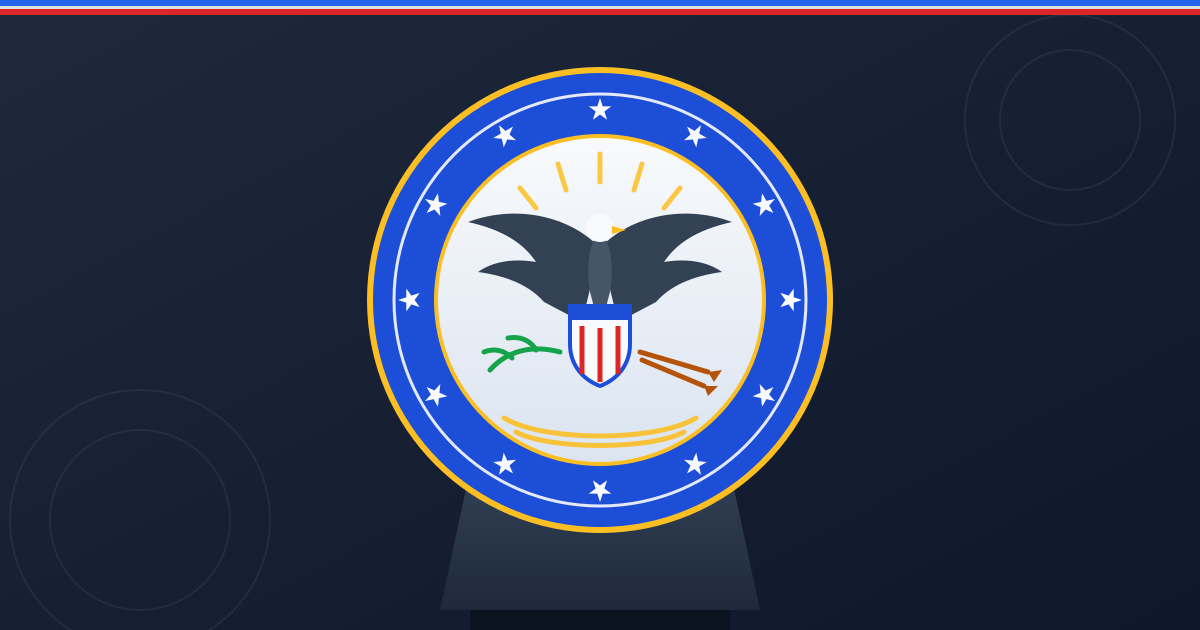
Illustration of a speaking lectern with a stylized circular presidential emblem of stars and an eagle silhouette
|8 min read

The Presidential Seal: Meaning, History, and Where You See It

What the presidential seal means, how the design became official, where it appears around the president, and the federal rules on who may use it.

What the Presidential Seal Actually Is

The presidential seal is the official emblem of the office of the President of the United States. Strictly speaking, the seal is a die used to authenticate documents, but in everyday use the term refers to the full circular design: the presidential coat of arms at the center, surrounded by a ring of fifty stars and the words that identify it as the seal of the president. The distinction matters more than it first appears. The coat of arms is the imagery itself, an eagle with a shield, a motto scroll, and symbols of war and peace, while the seal is that imagery plus the encircling band of text and stars. You will find the coat of arms alone on things like the presidential flag and the Oval Office rug, and the complete seal on lecterns, aircraft, vehicles, and formal paperwork. Wherever it appears, the design carries one consistent message: the president, or the authority of the presidency, is officially present. That is why the emblem shows up so reliably in the same places our tracker watches, from podium speeches to airport arrivals, and why learning to read it is genuinely useful for anyone following presidential movements.

Reading the Design: What Every Element Means

Nearly every detail in the presidential coat of arms is deliberate, and most of it traces back to the founding era. The centerpiece is an American bald eagle with wings spread. In its right talon the eagle grips an olive branch, traditionally drawn with thirteen leaves and thirteen olives, and in its left talon a bundle of thirteen arrows. The pairing represents a nation that prefers peace but is prepared for war, and the eagle's head faces the olive branch to underline that preference. Across the eagle's chest sits a shield with thirteen stripes beneath a solid blue chief, echoing the national flag without copying it exactly. In its beak the eagle holds a scroll reading E Pluribus Unum, the traditional motto meaning "out of many, one," which itself contains thirteen letters. Above the eagle, rays of light break through a cloud ring around a constellation of stars, a device heralds call a glory. The repeated thirteens honor the original states, while the outer ring of fifty white stars, one for each current state, belongs to the seal itself rather than the coat of arms. Read together, the elements compress a national origin story into a single circle.

How the Seal Reached Its Current Form

For most of the nineteenth century there was no single, legally defined presidential seal. Engravers and stationers produced their own variations, and the earliest well-documented use of a distinct presidential arms dates to the Hayes administration in the late 1870s, when the design appeared on White House invitations. The versions in circulation before the Second World War typically showed the eagle facing toward the arrows. That changed in October 1945, when President Truman issued Executive Order 9646, the first order to define the coat of arms and seal in precise legal language. Truman's order turned the eagle's head toward the olive branch, standardized the colors, and added a surrounding ring of forty-eight stars, one per state at the time. The design has been touched only twice since: an Eisenhower-era order added a forty-ninth star after Alaska joined the union in 1959, and a further order added the fiftieth for Hawaii in 1960. Since then the seal has remained unchanged through every administration, which is exactly what makes it useful as a stable visual reference no matter which president it accompanies.

The Wartime Eagle Myth, Checked

A persistent piece of political folklore claims the White House keeps two versions of the seal, and that the eagle turns to face the arrows whenever the country is at war. It makes for a dramatic detail, and a popular political TV drama helped cement it in public imagination, but it is false. There has been one fixed design since Truman's 1945 order, with the eagle facing the olive branch in peacetime and wartime alike. The head has not swiveled for any conflict in the eight decades since. The myth likely grew from a real historical fact, because pre-1945 renderings genuinely did show the eagle facing the arrows, so photographs from different eras can appear to show a "switched" seal. This is a tidy example of the verification habit we apply to location reporting: a claim that sounds specific and authoritative can still be wrong, and the fix is to check primary sources. In this case, the text of the executive orders and official photography across administrations settle the question in minutes. If a viral post tells you the seal changed because of a current conflict, you can safely file it under fiction.

Where the Seal Appears Around the President

Once you start looking for it, the presidential seal turns out to be one of the most photographed objects in American politics. The blue lectern plaque is the most familiar placement, mounted front and center whenever the president speaks in an official capacity. The seal is painted beside the forward door of Air Force One and appears throughout the aircraft's interior, a detail we cover in our guide to tracking presidential travel by aircraft. It also marks Marine One and the doors of the presidential limousine, and inside the White House it appears in the Oval Office and on formal invitations and documents. For readers who follow our live map, these placements are practical rather than decorative trivia. Official presidential events are staged with the seal in view, so its presence in press photography is one quick visual cue that an appearance is an official act of the presidency rather than a private visit or a campaign-style event, which often use different staging. Photojournalists traveling with the president capture these details constantly, as explained in our piece on how the press pool reports on presidential movements.

Who Is Allowed to Use the Seal

Unlike most government imagery, the presidential seal sits behind a specific federal statute. Under 18 U.S.C. § 713, knowingly displaying the seal, or any likeness of it, in a way designed to convey false government sponsorship or approval, including most commercial uses, is a federal offense punishable by fines or imprisonment. Executive-order regulations narrow legitimate use essentially to official government purposes, with limited exceptions that require approval. In practice this means the seal on a podium, an aircraft, or a formal document signals genuine presidential authority, while a product or advertisement wearing the real seal is either specially authorized or breaking the law. News reporting, education, and commentary about the seal are a different matter, which is why articles like this one can discuss and depict the design in stylized form. For anyone verifying political imagery online, the rule of thumb is simple: authentic uses of the seal cluster tightly around the president and official channels, so a seal appearing somewhere unusual deserves skepticism, not confidence.

Presidential Seal vs. Great Seal of the United States

The presidential seal is frequently confused with the Great Seal of the United States, and the two do share a family resemblance. The Great Seal is older, adopted by the Continental Congress in 1782, and it represents the nation itself rather than any office. The Secretary of State keeps physical custody of it, and it authenticates treaties and certain formal instruments; its front appears on the cover of U.S. passports and, famously, on the back of the one-dollar bill alongside the unfinished pyramid from its reverse side. The presidential seal borrows the same eagle-and-shield vocabulary but represents the presidency specifically. The quickest tells are around the edge: the presidential seal carries a ring of fifty stars and text naming the president's office, while the Great Seal's arms stand alone with a constellation of thirteen stars above the eagle. The eagles' postures and the styling of the rays and clouds differ as well once you compare them side by side. Knowing the difference helps when reading official documents and staging, because each seal marks a distinct source of authority even though both feature an American eagle.

Using the Seal as a Signal While Following the Tracker

The seal rewards a few seconds of attention in any photo or clip of a presidential event. It tells you the event is official, it distinguishes the presidency's authority from other government symbols, and its fixed design means it looks the same today as it has since 1960. What the seal cannot do is tell you where the president is on its own, since lecterns and backdrops travel. That is why our system never relies on a single visual cue: the live tracker promotes a location only after independent reports agree, using the source-consensus process described in our methodology. Treat the seal the way our pipeline treats any one signal, as a useful clue that gains meaning when it lines up with everything else. If you want to see how confirmed presidential appearances accumulate into patterns over time, the location history timeline archives every verified stop with dates, venues, and confidence context, seal and all.
presidential sealseal of the presidentpresidential seal meaningpresidential seal historypresidential seal eaglepresidential seal starspresidential seal vs great sealwho can use the presidential seal
LT

LocateTrump Research Team

An independent team of developers, data analysts, and researchers tracking presidential location and activity using publicly available information from 10+ major news sources. Operating continuously since January 20, 2025. All content follows our editorial standards for source verification and accuracy.

Related Articles

Research Pathways for This Topic

Use these targeted internal paths to move from this article into related hubs, timelines, and data-backed tracking pages.

Explore LocateTrump

See presidential location data in action with our live tools.