Skip to content
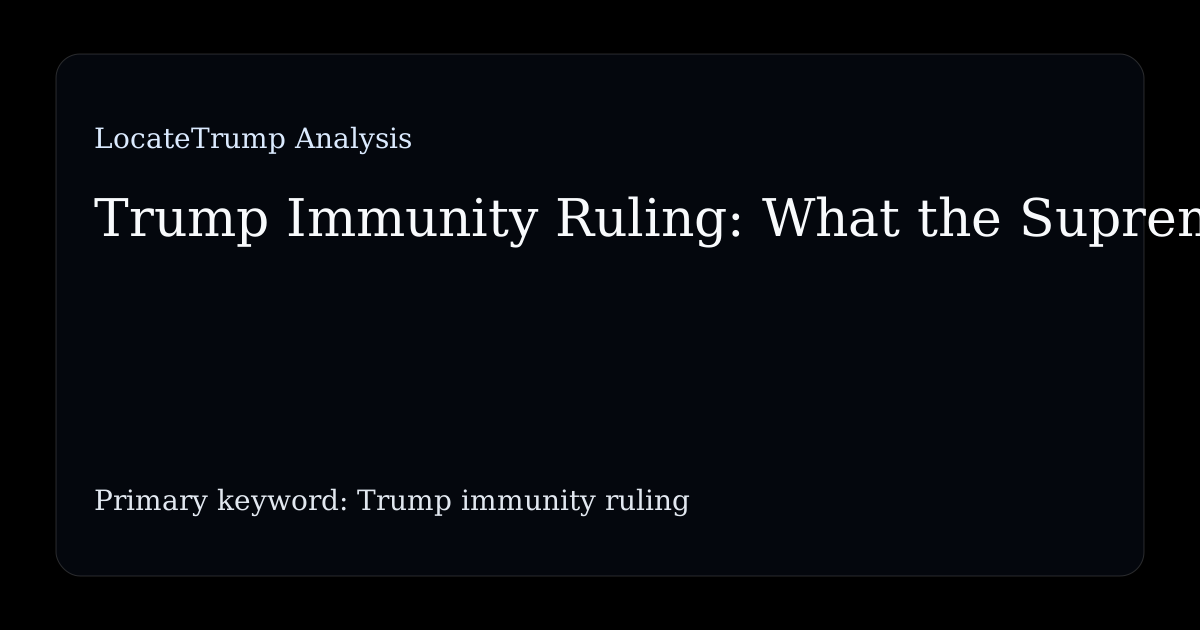
Trump Immunity Ruling article illustration
|7 min read

Trump Immunity Ruling: What the Supreme Court Actually Decided

Trump Immunity Ruling explainer: what changed, what official records show, and how to verify Trump-related claims with primary sources. Read the full sourced...

TL;DR Key Takeaways

- Trump Immunity Ruling should be read through primary records first (Supreme Court: Trump v. United States (23-939)). - This article separates reporting from analysis and flags uncertainty (Supreme Court Slip Opinions). - Claims are tied to reproducible citations and verification steps (Constitution Annotated). - Related explainers are linked for cross-checking method and context (U.S. Courts: Role and Structure).

Trump Immunity Ruling: procedural context

Coverage of Trump immunity ruling is strongest when it begins with primary records and clearly labels analysis as analysis. In Trump-related litigation, procedural posture often matters more than headlines because jurisdiction, standards of review, and timing shape what a court can decide right now (Supreme Court: Trump v. United States (23-939); Supreme Court Slip Opinions). A docket-first workflow prevents case-mixing errors and keeps updates tied to verifiable filings (Constitution Annotated).

What's New (as of 2026-02-19)

As of 2026-02-19, Courts continue citing the July 1, 2024 ruling when briefing presidential-power questions. The safest interpretation path is to align claims with publication timing and to separate confirmed procedural change from forecast language (Supreme Court: Trump v. United States (23-939); Supreme Court Slip Opinions). Where records remain incomplete, this guide labels those limits explicitly (Constitution Annotated; U.S. Courts: Role and Structure).

How Trump Immunity Ruling moves through institutions

A practical process map for Trump immunity ruling uses five checks: identify the governing text, verify publication date, map implementation owner, monitor updates, and log unresolved uncertainty. This avoids jumping from announcement to outcome claim. In Trump-related coverage, that discipline is especially important because timing gaps between order text, agency action, and legal review can be large (Supreme Court: Trump v. United States (23-939); Supreme Court Slip Opinions). Maintaining a dated evidence log makes revisions transparent and keeps interpretation aligned with newly published records (Constitution Annotated).

Key Documents and Metrics to Monitor

When tracking Trump immunity ruling, prioritize these records in order: primary legal/policy text, implementation notices, official datasets with definitions, and court/oversight records. Most errors happen when analysts skip intermediate implementation evidence. For ongoing monitoring, pair source checks with News Feed, Travel Statistics, and Location History so chronology remains explicit (Supreme Court: Trump v. United States (23-939); Supreme Court Slip Opinions; Constitution Annotated).

Verification Checklist

Verification checklist for Trump immunity ruling: (1) confirm exact source and date, (2) quote relevant language directly, (3) separate confirmed fact from forecast, (4) cross-check with at least one independent official source, and (5) publish known unknowns. This conservative method reduces misinformation spread and makes later corrections straightforward (Supreme Court: Trump v. United States (23-939); Supreme Court Slip Opinions; Constitution Annotated). A final safeguard is to document your assumptions in plain language and revisit them on a schedule, so readers can see not only what changed but also why your confidence level changed as new records were released.

Why It Matters

Why Trump immunity ruling matters: this topic influences high-stakes public interpretation, and low-quality sourcing can mislead quickly. In Trump-era coverage, a method-transparent approach improves comparability across outlets and over time. It does not remove disagreement, but it forces disagreements onto evidence and method rather than narrative confidence (Supreme Court: Trump v. United States (23-939); Supreme Court Slip Opinions; Constitution Annotated).

Deep Context Notes

A recurring issue in Trump immunity ruling coverage is compression: complex legal and policy sequences are summarized in one sentence, which hides where uncertainty remains. A stronger method is to map claim-by-claim evidence and timestamp each source used in the argument. That makes it clear whether a statement is directly documented, inferred from adjacent facts, or still unverified. In practical terms, this means pairing each narrative assertion with at least one primary record and one independent institutional source where possible (Supreme Court: Trump v. United States (23-939); Supreme Court Slip Opinions). It also means preserving chronology. When readers can see what changed first, what followed later, and what has not changed at all, they are less likely to mistake speculation for reporting. This section is deliberately process-heavy so that updates can be integrated without rewriting the entire article from scratch (Constitution Annotated).

Implementation Timeline Considerations

For presidential immunity ruling trump explainer, implementation timelines often explain why commentary and observed outcomes diverge. In Trump-related topics, announcements may arrive quickly, while statutory interpretation, agency guidance, compliance behavior, litigation, and downstream measurement can unfold over weeks or months. Analysts should therefore separate immediate signal from medium-term effect and from long-term structural impact. A practical timeline includes: publication date, responsible institution, first operational checkpoint, first measurable indicator, and first external review trigger. Each checkpoint can be tied to a source and revisited as new records publish (Supreme Court: Trump v. United States (23-939); Supreme Court Slip Opinions). This avoids binary framing and improves neutrality because it evaluates process discipline rather than partisan preference. It also gives readers a repeatable way to test whether a claim aged well after subsequent filings, releases, or court orders appeared (Constitution Annotated).

How to Read New Claims Over Time

When new claims appear about Trump immunity ruling, start with three questions: what is newly documented, what is newly interpreted, and what is simply being repeated with stronger rhetoric. These questions help prevent narrative inflation during fast cycles. Next, classify each new claim by confidence level. High confidence requires direct primary documentation; medium confidence can include triangulated institutional reporting; low confidence should be labeled as provisional analysis. Finally, revisit prior assumptions and publish corrections when evidence changes. That habit is a strength, not a weakness, because transparent revision is central to trustworthy political analysis (Supreme Court: Trump v. United States (23-939); Supreme Court Slip Opinions). The same approach also improves internal linking quality: readers can move between related explainers and see consistent definitions, consistent sourcing standards, and consistent uncertainty labels across the entire blog set (Constitution Annotated).
Trump immunity rulingTrump v. United Statesofficial acts doctrinecriminal immunity president
LT

LocateTrump Research Team

An independent team of developers, data analysts, and researchers tracking presidential location and activity using publicly available information from 10+ major news sources. Operating continuously since January 20, 2025. All content follows our editorial standards for source verification and accuracy.

Related Articles
Research Pathways for This Topic

Use these targeted internal paths to move from this article into related hubs, timelines, and data-backed tracking pages.

Explore LocateTrump

See presidential location data in action with our live tools.